Showing posts with label Holy Land. Show all posts

Thursday, September 19, 2013

My Pilgrimage to Israel (2013) - Part Eight

The Western or Wailing Wall - note the prayers written on paper that are
placed in the cracks in the wall (click to enlarge)


Our time on the Mount of Olives was followed by our initial entry into ancient Jerusalem and to Mount Moriah.  The Israelites considered Jerusalem the center of the world and the temple of God, erected by King Solomon, was contained within its walls.  In fact, the entire ancient city is contained within walls which currently stand perhaps seventy-five feet high.  Within the ancient holy temple was the Holy of Holies where the Arc of the Covenant (which contained the Ten Commandments) were once stored.  The Temple Mount is Mount Moriah where God gathered dust to create Adam and Abraham took his son Isaac as a sacrifice to God (see Part Seven).  God rested here when his presence filled the holy temple (Isaiah 8:18).

The Dome on the Rock


The location of the temple is now contained within the Muslim quarter and is known as the Dome on the Rock.  Only Muslim are able to worship in that location.  But, the original temple foundation still remains around the Temple Mount and those in the Jewish faith worship where these remnants of Solomon's temple remain.  The famously revered Western or Wailing Wall is the closest to the location of the Holy of Holies that they can worship.

Within the walls of the ancient city, Jesus was tried and beaten.  He then dragged his cross through the city streets as a form of humiliation.   We walked along this pathway (the Via Dolorosa or Way of Suffering) through the markets that probably aren't much different than when he suffered here.

While walking along the Via Dolorosa, we stopped in Bethesda.  In this location, described in the Gospel of John, Jesus healed a man that was unable to walk.  Outside of John's description, the pool was not know to exist until it was excavated in the 19th century.  The pool is just as described in the bible.

Saint Anne's in Bethesda (note the Mourning Dove on the cross!)

Street along the Via Dolorosa


Adjacent to Bethesda is Saint Anne's Church which is near the location of where Jesus was beaten prior to being crucified.  Our group assembled inside to sing a hymn that was interrupted by the shadow of a Mourning Dove's wings flapping above the alter as the bird attempted to land on a light. 

The shadow, appearing not unlike that of an angel's wing, was cast across the entire 25 foot wall above the alter while flapping...then, as we continued singing, the dove flew just over our head's in an arc returning to the alter where it landed on the cross.  Because of the important role that doves play in the bible, I knew this was intentional and was put into play by God for our small congregation.  I think of instances where God used doves in the bible like when the Holy Spirit descended from heaven "like a dove" when Jesus was baptized or the dove that landed on the ark after the great flood.  I'm not entirely sure of the meaning with "our dove".  But, I believe that it was a sign that we could find rest in Christ.  This was a beautiful way to begin our walk along the Via Dolorosa that leads to where he was crucified.

Church of the Holy Sepulchre

Russian Orthodox Pilgrims at Anointing
Stone - Church of the Holy Sepulchre


Along the Way of Suffering, we would hear stories about the day that God gave his only son...for He so loved the world.  In a strange mix of somberness and gratitude, we walked along the road and heard various stories that occurred at each of the Stations of the Cross.  Finally, we wound our way outside of the original city walls to the Church of the Holy Sepulchre.  Within the area now enclosed by the walls of this building, Jesus was crucified, entombed and resurrected.  This site is considered by many as the most important pilgrimage destination for Christians since it was built in the 4th century. 

In the Church of the Holy Sepulchre, you can kneel to touch the rock on which Jesus' cross was raised.  This is the location that he gave up his spirit.  The idea that one is standing on this rock is overwhelming for any follower of Christ.  But, because of the pace of our trip, I felt somewhat rushed and unable to fully absorb the magnitude of where I was.  Fortunately, the following day, I was able to return to this 1600 year old building to worship.  It was a quiet morning and I was able to spend a lot of time alone with God on Calvary.  I read John's gospel account of that day as I prayed silently...occasionally kneeling to touch the rock.  

"But Mary stood weeping outside the tomb, and as she wept she stooped to look into the tomb. And she saw two angels in white, sitting where the body of Jesus had lain, one at the head and one at the feet. They said to her, “Why are you weeping?” She said to them, “They have taken away my Lord, and I do not know where they have laid him.” Having said this, she turned around and saw Jesus standing..." John 20.


Pilgrims from our group waiting to touch the rock of Calvary - Church of the Holy Sepulchre


Saturday, August 31, 2013

My Pilgrimage to Israel (2013) - Part Seven

Our group overlooking Jerusalem from the Mount of Olives (picture by James Stewart - again)

If Galilee is steeped in New Testament history, Jerusalem is where the Old Testament and New Testament converge.  The ancient Hebrew nation centered life and worship in the location (Mount Moriah) that Abraham warily took his son Issac with the intent of sacrificing him.  That act was merely foreshadowing the act of God sacrificing his own son.  Abraham told Isaac: "God himself will provide the lamb for the burnt offering, my son" (Genesis 22:8).  Abraham's lamb represented the Lamb of God that would be sacrificed thousands of years later.  We would retrace that Lamb's steps as he inched his way from the Mount of Olives...to the temple...to Golgotha or Calvary.

Bethphage Church (photo by James Stewart) - click to enlarge


Bethphage sits on the Mount of Olives and was an ancient village overlooking Jerusalem.  Jesus mounted the colt of a donkey and rode into Jerusalem on what is now celebrated as Palm Sunday.  It was to Bethphage that Jesus sent his disciples to find the donkey.  While standing here, you can almost imagine the crowds in the city awaiting his arrival while they celebrated Passover "Blessed is the King who comes in the name of the Lord!".  Even though Jesus told them, little did anyone know that his triumphal entry included scourging and crucifixion.  Again, he confounded man's earthly intellect with a story that could only be written by God.
David Hayes and me from where Jesus wept over the city of Jerusalem

We left Bethphage's Franciscan church by descending an ancient route quite undoubtedly used during Jesus' entry into the city.  This was a quiet and sunny Sunday morning perfect for this memorable part of our journey.  After a short time, we descended to a point where we could overlook the city of Jerusalem.  As Jesus descended into the city, he paused to mourn over Jerusalem and foretold the fall of the temple.  

Dominus Flevit Church commemorates where Jesus wept over Jerusalem (note the reflection of Jerusalem - photo by James Stewart)

Garden of Gethsemane
One of the most spiritually moving parts of our trip was our Sunday morning worship service in the Garden of Gethsemane.  So, we are walking along the trail of Jesus' descent and stopped in the garden where he prayed on the night of his arrest...incredible.  I could hardly believe that we were here.  But, to spend the Lord's day morning in worship here was absolutely amazing.  Jesus prayed here while James, John, and Peter slept (even though he kept asking them to stay awake).  He first prayed that the father would protect him from what was about to occur.  Jesus was afraid and wanted to be spared.  But, as his prayer continued, he understood and accepted the father's will.  I am deeply encouraged by a God who knows how it feels to be fearful and discouraged - who is comforted by the company of others during times of trial.  I am also encouraged that he forgave those slumbering disciples.    

Crown of Thorns Tree - Dominus Flevit


Our accompanying pastors led the worship service.  David offered a most appreciated opportunity for each of us to worship in quiet solitude.  As mentioned in an earlier blog post, our regular Sunday worship meetings include lengthy segments of silent prayer.  I have grown to greatly appreciate and rely upon this manner of worship.  So, I was heartened when David asked us to retreat into the garden for silent reflection.  We were to return to the group when we heard singing.  But, I decided to stay quietly next to that old olive tree and pray in silent thanksgiving.

Next stop:  Jerusalem

Tuesday, August 27, 2013

My Pilgrimage to Israel (2013) - Part Six

Church of the Nativity in Bethlehem (photo by James Stewart)
David told me that I would gain appreciation for the biblical concept of "the ascent to Jerusalem" during the bus ride from Qumran to Jerusalem.  He was right.  As we drove along the West Bank highway toward the city of Jerusalem, the nose of our bus pointed upward - and the engine groaned the entire way.  We were ascending to Jerusalem along the Judean Hills (desert hills not unlike those surrounding Jericho).  This ascent is also a foreshadowing of the coming ascent to the heavenly Jerusalem and also traces the ascent of Jesus to Jerusalem as he journeyed toward his crucifixion.   

During each leg of our trip to Israel, we would pause to read scripture that was related to the area we were visiting.  I had volunteered to read for the group as needed and was asked to read various passages from Psalms into a microphone as we drove up the incline toward Jerusalem.  While I sat in a small seat near our Palestinian bus driver, I had a perfect view through the massive windshield on this very sunny day.  Reading the Psalms seemed easy enough - until it wasn't.  As I finished the final passage, as if  exactly on queue, we rounded the mountain to see the city of Jerusalem appear on the hill ahead.  It was a breathtaking site and invokes one to wonder what Christ thought as he walked this path toward his crucifixion...we would have many more opportunities to reflect on his experience during the days ahead. 

 "I lift up my eyes to the mountains - where does my help come from?  My help comes from the Lord, the Maker of heaven and earth.  He will not let your foot slip - he who watches over you will not slumber; indeed, he who watches over Israel will neither slumber nor sleep.  The Lord watches over you - the Lord is you shade at your right hand; the sun will not harm you by day, nor the moon by night.  The Lord will keep you from all harm - he will watch over your life; the Lord will watch over your life; the Lord will watch over your coming and going both now and forevermore." - Psalm 121 (Song of Ascent)

Today, we would drive through Jerusalem into the once small village of Bethlehem - now a Palestinian city within the West Bank.  My perception of Bethlehem had always been that it was located far away from other cities and towns.  However,it sits only 2 or 3 miles outside of the large city of Jerusalem.  Again, the close proximity of these sites astounds me.  It is a perspective that is hard to have without physically experiencing it.

Church of the Nativity in Bethlehem (photo by James Stewart)
The Door of Humility


The first site we visited was the Church of the Nativity.  The original basilica built on this site was in 327 AD by Helena the mother of the Emperor Constantine (Helena was responsible for many of the sites we visited during the trip).  The original building was destroyed and another rebuilt on the same site in 565 AD.  There is significant evidence that this church sits upon the actual site on which Christ was born.

On a building this large, one would expect a grand entry.  However, the Door of Humility is a small door through which you have to stoop to enter.  This door is the main entrance.  Much like the act of being on one's knees during prayer has a positive effect, the act of stooping while entering such a place reflects our reverence.  As I walked through, I reached up to touch the doorway and paused in a moment of thanksgiving.

We entered the cave where Jesus was born where we stayed for a few minutes and contemplated the significance of the place.  Why did our really big God choose a small humble stable cave for the birth of his only son?  How significant is the fact that Jesus was not born in a palace?  What does God want us to learn from this?  Most followers of Christ believe that he wanted to reinforce that the true kingdom is not of this world, that his values are not the same as the world's and pride should have no place in a person's heart.  That God has a deep affection for the lowly and the least.   


The star on the floor marks the traditional location of Jesus' birth

After leaving the Church of the Nativity, we visited Shepherd's Field and Grotto.  You will recall that an angel appearing to the shepherds of the field in order to inform them of Jesus' birth.  This field may or may not be that same field but, it doesn't matter.  It is serene and was certainly a shepherd's field close to the birthplace of Jesus.  "An angel of the Lord appeared to them, and the glory of the Lord shone around them, and they were terrified.  But, the angel said to them, "Do not be afraid.  I bring you good news that will bring great joy for all the people.  Today in the town of David a savior has been born to you; he is the Messiah, the Lord." - Luke 2:9-11


Shepherd's Field and Grotto - Bethlehem

To imagine that scene while visiting here might only be better at night - maybe on Christmas Eve.  We were again reminded that God chose the lowly when he chose shepherds to announce the coming of the Jesus.  Pride should have no place in a person's heart and the shepherds had nothing of which to be proud.  They were second-class citizens in their time.  While man had determined that a shepherd's testimony could not be consider valid in any court, God felt different about the idea of social status.  In fact, he allowed them to be witness to a most important event, the birth of the Lord.  They must have felt pretty good about their role and how God has a deep affection for the lowly and the least.

Next stop:  The Mount of Olives, Jerusalem

Saturday, August 17, 2013

My Pilgrimage to Israel (2013) - Part Five

Jericho - the oldest city in the world
Leaving the Galilee region of Israel, we drove along the Jordan River that runs along the border of Israel and Jordan.  During the drive, we could see the countries of Syria, Lebanon, and Jordan for a short time.  While the Galilee region is lush with green plant life, much of the area of the West Bank lying east of the mountain range is extremely arid.  The rocky peaks along the road toward Jericho are speckled with caves that have housed people for thousands of years.  At one point during the drive through Samaria, Tsippi pointed to the top of a nearby hill where Jacob's well is located.

Mt Nebo as seen from Jericho

Without much background, the story of Jesus speaking to the Samaritan woman at this well, would not seem unusual.  The meer fact that Jesus was in the vicinity of Samaria was radical enough.  But, to be speaking to an Samaritan woman who had been divorced 5 times and was living with another man was considered outrageous.  Samaritans were considered unclean and not to be associated with - add this background about the woman and you can imagine how scandalous this must have been (even Jesus' disciples questioned him).  But, again Jesus demonstrated that he came not to condemn but to save.  I'm not sure who the Samaritans of our day are...but, I think we could name a few if we thought about it long enough.


Greek Orthodox - Monastery of Temptation


Jericho is the oldest city in the world.  It sits across the River Jordan from Mount Nebo.  You may recall that Moses never stepped foot on the soil of the promised land of Israel.  He stood on the top of Mount Nebo from where he saw this place...and was buried there after freeing the Hebrew nation from the slavery in the land of Egypt.  The city was taken by the Hebrews led by Joshua without military force. Again, God didn't want anyone to be confused about who was responsible for the city being delivered to the Israelites.  God gave Joshua instructions that must have had the Israelites questioning their sanity: march around, blow trumpets, and yell really loud.  That's it.  The walls fell.  God did it.

Sitting above the city, the Monastery of Temptation is carved into the mountainside.  This ancient monastery sits above a cave thought to be where Jesus spent some of his 40 days of temptation in the wilderness while meditating and fasting.  Jesus also healed Bartimaeus of his blindness in Jericho.

Next, we went to Qumran which sits in the Judean desert next to the Dead Sea.  As Jericho is the oldest city in the world, the Dead Sea is the lowest place on the planet.  Outside of the small visitor center, this place seems to be stuck in the Old Testament ages.  That time in history is appropriate because this is where the Dead Sea Scrolls were discovered.  These scrolls, written by an ancient Jewish sect called the Essenes, included all but one book of the Old Testament and are dated to approximately 400 BC.  

Qumran - photo by James Stewart

The scrolls have helped substantiate the fact that the Bible is the most recounted ancient manuscript known to exist.  It is entirely unique among antiquities in that hundreds of iterations from different sources reaffirm the same stories.  The scrolls were written to preserve the word of God and have also reaffirmed what our Bibles contain.  


Essene Scroll Writing Room (Dead Sea in background)


Within the scrolls, the Book of Isaiah was found to be accurate matching our current translations down to the most minute details.  "But he was pierced for our transgressions, he was crushed for our iniquities; the punishment that brought us peace was upon him, and by his wounds we are healed.  We all, like sheep, have gone astray, each of us has turned to his own way; and the LORD has laid on him the iniquity of us all." - Isaiah 53:5-6.  

These words were written by the prophet Isaiah 600 years before Jesus was crucified.  Also, Isaiah 53 is extremely fascinating in that it contains the only physical description of Jesus in the Bible:  "He had no beauty or majesty to attract us to him, nothing in his appearance that we should desire him.  He was despised and rejected by mankind, a man of suffering, and familiar with pain.  Like one from whom people hide their faces he was despised, and we held him in low esteem."  Next stop Bethlehem...where he was born.


Thursday, August 8, 2013

My Pilgrimage to Israel (2013) - Part Four

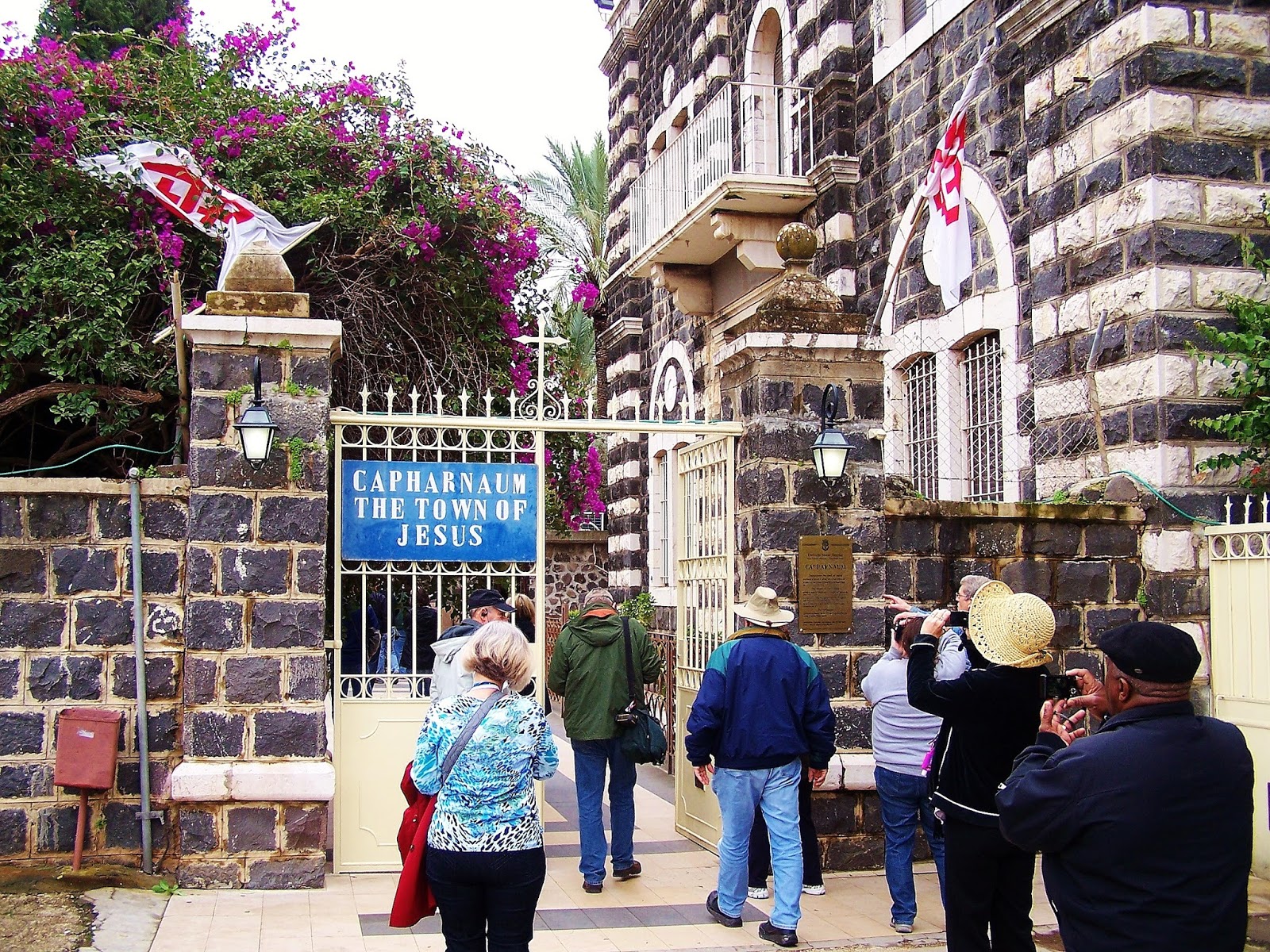
Capernaum was home to several apostles - pictured are disciples from our tour group
Before this trip, I could not imagine being in any one of the locations we have visited.  On this day, we had been to four significant biblical sites and it wasn't even time for lunch!  After the Mount of Beatitudes and some very deep and meaningful worship, we entered one of the most significant towns in the New Testament:  Capernaum.  Several of Jesus' apostles came from this ancient fishing village located on the northern shore of the Sea of Galilee.  Simon Peter, James, John, Andrew, and Matthew are believed to be from Capernaum.  The Gospels recount that Jesus taught in the synagogue in this town.  He also healed many people including Peter's mother-in-law and the paralytic [that was lowered through the ceiling to reach Jesus] here.

4th Century synagogue which sits upon one in which Jesus taught
(the darker stone at the bottom is the original's foundation)
Amazingly, excavations have revealed the remains of the original synagogue where Jesus taught.  That synagogue is located directly beneath a second, 4th century synagogue.  We stood directly over the site where the Messiah taught: "I am the bread of life.  Whoever comes to me will never go hungry, and whoever believes in me will never be thirsty".

Within yards of this amazing site, there is also a church built over the home of the Simon Peter: this village was inhabited from the time of Christ until the 4th century.  During the 4th century, it was discovered that one of the homes underwent a great transformation that included meticulous care and inscriptions on the walls, plaster flooring, and ceremonial lighting.  Later, a church was built directly over this same home.  This site is the home of St. Peter.

A Catholic Church straddles Simon Peter's home

The town of Capernaum - The Sea of Galilee is in the background
I, like so many other Christians, can relate to Peter.  He was an exuberant follower of Christ that was simply a knucklehead at times.  One minute Peter asked Jesus to help him to walk on water.  The next, he is scared and lacking faith to the degree that he begins sinking.  Thinking that he needed to protect Jesus, he cut off a soldier's ear (that Jesus then healed) then only hours later denied he even knew Jesus.  After spending three years with Jesus, Peter still couldn't grasp what Jesus meant.  But, when he finally did, he became so very instrumental in growing the church.  Peter gives hope to many that realize that God used, and continues to use, the most unlikely of characters to accomplish his purposes.  It is one of the most reaffirming stories in the Bible.          

Next, we visited a local museum that featured a 1st century fishing boat that had been recently located in the Sea of Galilee.  The boat is believed to be of typical design as those used during the time of Jesus.  We then boarded a boat for a trip across the very body of water where Jesus walked upon water.  Once in the middle of the lake, we cut the engine and enjoyed a devotional on the calm, quiet waters of the Sea of Galilee.  These moments were deeply appreciated as they allowed for silent reflection.  The Quaker tradition of worship incorporates a fair amount of silence.  It is during this time that these disciples listen to the Spirit of God...or just pray silently.  We also share or testify to one another if the Spirit moves us to do so.  For most of the week, I took advantage of every opportunity to worship in this manner.  It was fantastic.

Sea of Galilee by boat - picture by James Stewart
    
For lunch, we ate St. Peter's fish!  The type of fish we ate is the only fish that is native only to these waters.  They are plentiful...and delicious.  It was a nice way to honor this place.  Soon after lunch, we went to the Jordan River baptismal site where I was baptized by Pastor David Hayes.  These are the waters in which John the Baptist baptized Jesus: "And when Jesus was baptized, immediately he went up from the water, and behold, the heavens were opened to him, and he saw the spirit of God descending like a dove and coming to rest on him."  Several of us took part in water baptism.  I was pleased to have the opportunity to share in the tradition of water baptism with other disciples in the waters where Jesus was baptized.  The river was very cold.  But, I felt nothing but blessed.

Next stop:  Jericho (the oldest city in the world) and Qumran


Wednesday, July 31, 2013

My Pilgrimage to Israel (2013) - Part Three

Pilgrimage - 1) a journey to a sacred place or shrine trip, 2) a long journey or search, especially one of exalted purpose or moral significance.


Day Two: this portion of the trip was as significant as any of the week: an early morning departure for a day at a variety of significant sites along the shore of the Sea of Galilee (also known as the Sea of Tiberius which is really a big lake surrounded by very hilly terrain).  Jesus spent a lot of time during his ministry in the area around the Sea of Galilee.  He also gathered his apostles, performed many miracles, and reappeared after his resurrection in this area.  Before coming to Israel, I tried to imagine what it would be like to walk along these shores, but I couldn't quite grasp what the experience would be like.  This is one of the legs of the trip that I was most excited to experience.


The Valley of Winds - Via Maris - picture by James Stewart
On our way to our first destination, The Valley of Winds - Via Maris, we drove past the village of Migdal.  This small village is a relatively new excavation and was once the home of Mary Magdalene.  Jesus was considered radical in so many ways including how he broke with societal norms when he included Mary in his ministry.  He turned the values of the world upside down and that included his treatment of all women.  Mary was with Jesus during his crucifixion, was the first to see the resurrected Christ, and announced that he had risen to the other apostles.  To see Mary Magdalene's humble village, even if just from the road, was inspiring.

Church of the Primacy of St Peter


We started the day at The Valley of Winds - Via Maris which is an ancient trade route pathway that leads through the mountainous terrain surrounding the Sea of Galilee.  It was very heavily traveled during Jesus' time and would have been used by anyone visiting Migdal and Capernaum.  In other words, Jesus undoubtedly used this road when he traveled from Nazareth to visit Peter, James, John, Matthew and Andrew in Capernaum.  Caves at the top of the tall mounts attest the age of this place.  It was serene, extraordinarily peaceful, and beautiful during this early morning.  Many of the group said that this was one of their favorite places.  We were right in the middle of a sacred place.  The atmosphere was palpable.

After considering Jesus' journeys through these valleys, we traveled along the shore of the Sea of Galilee to Taghba.  Within Taghba, there are two significant locations in Christian history: the Church of the Multiplication and the Church of the Primacy of St. Peter.  Among other evidences, these two buildings sit atop two 4th century churches that were built to honor one of Jesus' reappearances after his crucifixion and the miracle of the multiplication of loaves and fishes.  Both of these sites sit along the shores of the Sea of Galilee.


Sea of Galilee at Church of the Primacy of St Peter
"Early in the morning, Jesus stood on the shore, but the disciples did not realize it was Jesus" - this is the story where the resurrected Jesus appeared to his disciples again and instructed them, after they were unable to catch fish, to throw their net "on the right side of the boat" and they caught a large number of fish.  It is a wonderful story of God reuniting with his followers and encouraging them.  This is also where Jesus asked Peter three times "do you love me?".  After Peter answered each time that he indeed did love Jesus, the Lord instructed Peter to then "feed my sheep".  A wonderful and loving exchange.

After a walk along the road to the Church of the Multiplication (honoring where Jesus fed the multitudes), our bus left for the Mount of the Beatitudes.  Again, there is no absolute proof that this is the area where Jesus delivered the powerful (and extraordinarily challenging) Sermon on the Mount.  But, there is good evidence why these locations have been honored as such for 1600 years.  Even so, as our tour guide Tsippi stated, we didn't come to honor the site but to honor the event...to honor the Creator.

The Mount of Beatitudes is probably the most beautiful of all the sites we visited.  We stood next to the basilica, overlooking the Sea of Galilee and the Mount of Beatitudes, while Shelly Hayes read the Sermon on the Mount; Pastor Arturo Maine from Costa Rica by way of New York, read the same scripture in Spanish (Matthew 5-7)...blessed are the poor in spirit, because theirs is the kingdom of heaven...blessed are those who mourn, for they will be comforted...blessed are the meek, for they will inherit the earth...blessed are those who hunger and thirst for righteousness, for they will be filled...  I stared over the Sea of Galilee and intermittently prayed silently while these disciples read these cherished scripture.  We entered the basilica, sang a hymn (well, some sang...I usually hum because my memory of lyrics is terrible) and prayed.  I absolutely love this place.

Sea of Galilee from Mount of Beatitudes - the view from where I stood while we read the Sermon on the Mount


Next stop: Capernaum, Crossing the Sea of Galilee, and Jordan River

Saturday, July 27, 2013

My Pilgrimage to Israel (2013) - Part Two

View of Nazareth (upon the hills in background) and Mt. Tabor (on the right) from Megiddo
Day One (cont'd) - Our time in Caesarea was followed by a trip to ancient Tel Megiddo which translated to Hebrew is Har Megiddo or Armageddon.  The Book of Revelation describes a great end-times battle when all of the world's kings assemble in the valley of Armageddon.  26 civilizations dating back thousands of years before Christ are known to have been located on this ancient site that juts above the fertile valleys.  King David conquered Tel Megiddo after the failed attempts of others before him.  The city reached its height during the reign of the wise King Solomon (David's son).  This place is incredibly rich in biblical history.  

Manger from time of Christ - Tel Megiddo
After waiting out the rain while having lunch, we walked to the top of Tel Megiddo.  Despite the historical significance of this place, it is quite open to those who want to wander alongside its excavations. Even the pathways leading to the top are littered with thousands of ancient pottery shards underfoot.

Standing on top of the hill, I was struck by the close proximity of so many other significant biblical sites.  You could easily see Mt Carmel (see Israel - Part One), Mt Tabor, Mt Gilboa, Jezreel Valley and Nazareth.  Names associated with these places include Jesus, David, Solomon, Saul, Josiah, Gideon, Elijah...absolutely incredible.  One of the most inspiring of the Old Testament stories is that of Gideon.  That story happened in the valley in front of us.


Gideon's defeat of the Midianites happened in the Jezreel Valley.  Gideon's army was reduced to 300 men because God directed him to shrink his numbers.  God, in his wisdom, determined it best to demonstrate his strength through this small and weakened military (see "Our Weakness, His Strength").  Thus, there was no mistaking who controlled the outcome of the conflict.

Nazareth from Mount Precipice
As we wound our way from the top of the ancient hill, I was reminded of the same principal [that God demonstrated through Gideon] when Jesus was born.  Along the path sits a 1st century stone manger.  Christian, your King was not born in a position of power; he wasn't laid in a posh palace bed.  He was born in a cave used to house dirty animals and slept in a feeding trough made of stone.

While in Megiddo, I was completely transfixed on the small town of Nazareth that can be easily seen, sitting seemingly quiet atop a range of hills, across the the valley.  Jesus spent most of his childhood and adult years there.  God chose that small, unimportant town to be the home of his one and only Son.


For at least 1,600 years, this stone cave has been
celebrated as the young virgin's home
Nazareth sits in a bowl shaped indention on top of the hills overlooking Megiddo and the Jezreel Valley.   It occurred to me that, during his upbringing, Jesus would undoubtedly look over these same hills and valleys while standing on the ridges surrounding his town.  Before entering, we stood above the city Mt. Precipice - this is the location that is believed to be where the people of Nazareth attempted to kill Jesus before he "passed through the midst of them and went away".  Whether this was the exact cliff on which they attempted to kill him is not important.  I had no doubt that he once walked as a man - probably played as a boy - where we were standing.

Descending into Nazareth, we walked to the Basilica of the Annunciation.  This basilica sits upon ancient sites believed to be where the young virgin Mary lived and where the angel Gabriel appeared before her to say "Do not be afraid, Mary; you have found favor with God.  You will conceive and give birth to a son and you are to call him Jesus."  The village was very small during Jesus' time.  So, the likelihood remains that Jesus also lived, learned of His Father, and worshiped in this location.  To think that my God had resided in this humble little village was as spiritually moving as anything that I have ever experienced.

Next stop:  The Sea of Galilee


Saturday, July 20, 2013

My Pilgrimage to Israel (2013) - Part One

Theater in Caesarea where St Paul testified to Herod Agrippa 
I had maintained a list of personal and professional goals for several years.  Some of the goals were short-term in nature.  Those would include items such as "read # books in 2013".  Other objectives would be longer term such as personal and professional aspirations, etc.  Most of my goals seemed noble enough.  However, in January 2012, I decided to clean the slate to "recalibrate" - to assure that I was properly aligning myself with God's plans.  So, I immediately eliminated every line-item on that sheet except one - a trip to the Holy Land.  I had that one marked as a "sometime before I die" objective.  One month after making these changes, my friend Pastor David Hayes, announced that he was arranging a January 2013 trip to Israel.  He was inviting whomever would like to join him in this pilgrimage.  I immediately contacted him to get the details.

Usually, a year in advance, most things seem easily doable.  That is, until the idea of leaving your wife and children behind as you hop a jet bound for the middle-east starts playing tricks on your mind.  It seemed that every fiber in my being was telling me that it wasn't a good idea.  In fact, only 6 weeks before we left, rockets were being sent from Gaza toward Tel Aviv (the very city in which we were scheduled to land). Nonetheless, as the trip approached, God made it very clear to me that this trip was meant to happen...and I followed his lead.

With the exception of a couple that were meeting us in Israel, our entire team assembled in Philadelphia.  We were joined by a group of Christ followers from Tennessee, Alaska, Indiana, North Carolina, New York, and Alabama.   After a long 12 hour flight, we landed in the rainy city of Tel Aviv and jumped on a bus headed for Galilee.  Within 10 minutes of leaving the airport, our tour guide informed us that we were in the land of the ancient Hebrew tribe of Benjamin.  That announcement was enough to start my head spinning and stirred a tremendous amount of reflection and emotion.  Soon after, we could see an outline of Mt Carmel where the prophet Elijah (you know, the guy who flew off to heaven in a fiery chariot) confronted the false prophets.  I was right in the middle of the land of the Holy Bible...of milk and honey...of Abraham, Isaiah, King David, John the Baptist and Jesus Christ.  To say that I felt inspired and somewhat overwhelmed is a major understatement.

I once read that 80% of Jesus' ministry took place in Israel's northern region of Galilee.  Our home base for three nights was in Galilee's ancient Roman city of Tiberius situated on the Sea of Galilee.  It was from this location that we would drive to visit Caesarea (also an ancient Roman city), Tel Megiddo (Armageddon), Nazareth and Bet She'an on our first day.

Caesarea sits on the Mediterranean Sea where 2,000 year old pottery shards are still washing ashore.  The Apostle Paul was imprisoned here for two years (either in Herod's palace or Pontius Pilate's residence) because of his testimony about Jesus Christ.  As our tour guide, Tsippi, explained the facts behind Paul's imprisonment, a rainbow (a biblical sign of God's promise to man after the great flood) sat over the location of his imprisonment.  Tsippi exclaimed: "God is so good".  There is no doubt in my mind that we were supposed to be there at that very moment - and I was glad that I followed God's lead.

Next stop: The Valley of Armageddon - the location where John prophesied the final battle between good and evil.